
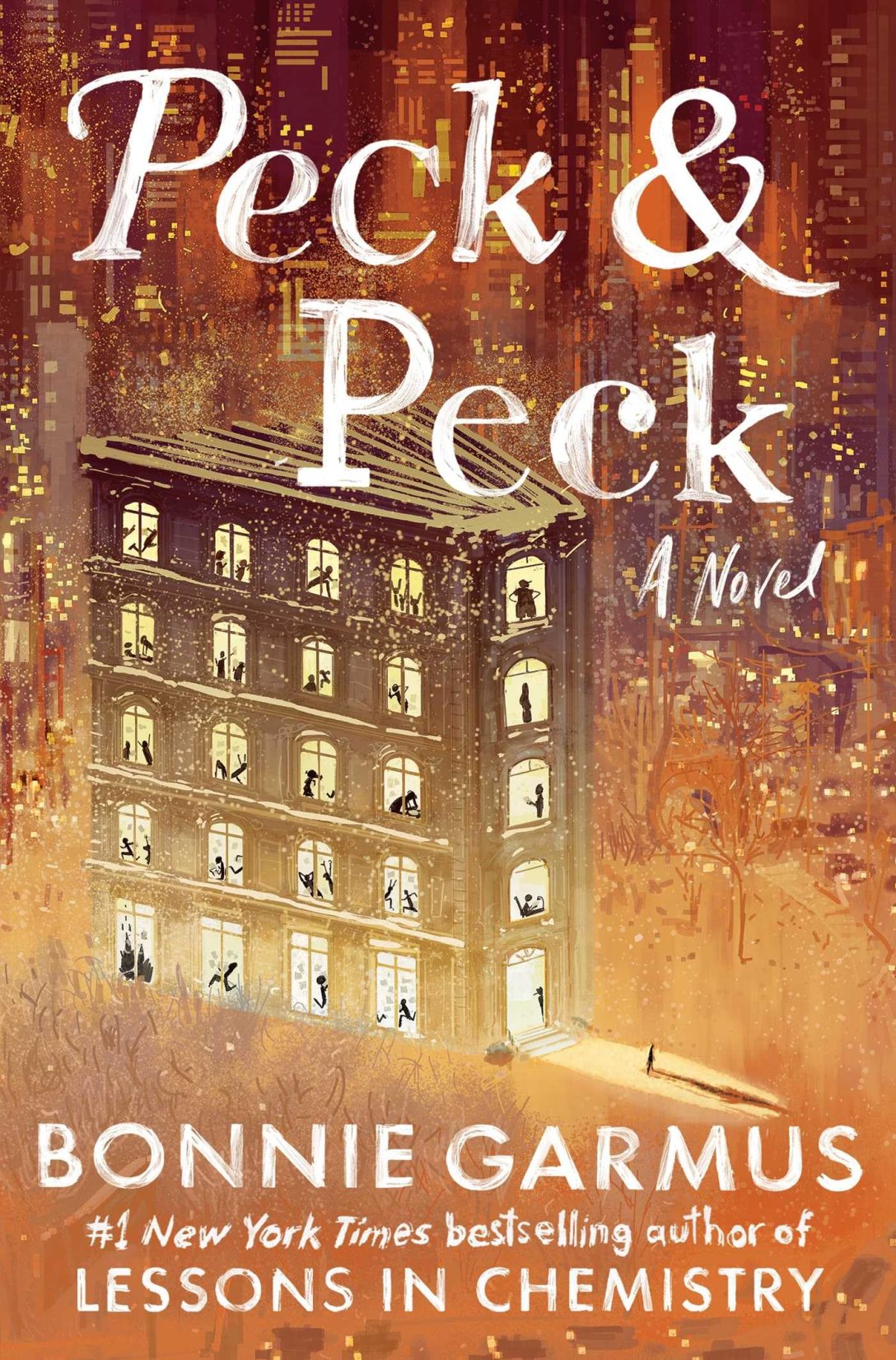
Well, that’s it. I’m throwing in the towel. After reading Peck & Peck, I may never have the audacity to call myself a writer again. Bonnie Garmus is just that good. Everything I’ve ever written suddenly seems like something that should be hanging on a kindergarten classroom wall.
Having written one of my all-time favorite novels, Lessons in Chemistry, Garmus has once again delivered what I like to call a “lessons” book. This time, we get lessons in poetry, typesetting, fonts, loyalty, friendship, girls, dogs, workplace etiquette, copy machines, editors, law, arson, bird eggs – you name it. I feel as though I should have earned at least a few college credits by the time I finished.
Our protagonist, Batter Gray, is a young man trying to make his way in New York City in 1982. Batter is not a poet, but he possesses an extraordinary ability to distinguish good poetry from bad – a rather unusual talent and not one that lends itself to an abundance of employment opportunities. When he finally manages to secure a position at the highly esteemed poetry journal Peck & Peck, he thinks he’s hit the literary jackpot.
What Batter discovers, however, is that the literary world is every bit as dysfunctional as the rest of the world, perhaps even more so. Between the feuding twin brothers who run the publication, the peculiar personalities of its editorial staff, and the rather extreme measures taken to dispose of inferior poetry, Batter finds himself in a workplace that probably could have benefited from an entire department of mental health professionals. As someone in the publishing business, I found some of this particularly amusing. And no, I will not be adopting their editorial policies.
What I absolutely love about Garmus’s writing is her extraordinary sense of humor. Reading her novels is almost like listening to someone tell a wonderfully funny story while simultaneously carrying on a separate conversation with herself. She fills in the gaps with witty observations, snide little remarks, and brilliantly timed asides. Sometimes those asides are even funnier than the story itself.
I instantly fell in love with the poetry-obsessed Batter as he navigates his increasingly wild and bizarre adventures in New York City, surrounded by an assortment of eccentric characters, all while living his dream. Well, kind of. As it turns out, dream jobs are considerably more complicated when the people running the organization are certifiably ridiculous.
What amazes me most about Garmus is her ability to take seemingly mundane subjects and make them utterly fascinating. Who knew that fonts, copy machines, and the inner workings of a poetry journal could be so entertaining? She manages to educate her readers without ever making them feel as though they’re being educated.
And then there are the more meaningful lessons woven throughout the novel – about friendship, loyalty, integrity, originality, and finding one’s place in the world. Garmus delivers them without becoming preachy or sacrificing an ounce of humor.
How does someone write so well that 418 pages fly by, and you find yourself reading not only the acknowledgments but even the permissions? The permissions, for heaven’s sake! Apparently, I wasn’t quite ready to leave Bonnie Garmus’s company.
There are good writers, there are great writers, and then there are writers who make other writers reconsider their career choices. Bonnie Garmus falls squarely into that last category.
But perhaps the most valuable lesson for me came from Batter himself. He wasn’t a poet, but he knew exceptional poetry when he read it. Hmmm. Perhaps I need to come to terms with the fact that my greatest literary talent may not be writing but recognizing good writing when I see it. And judging by my appreciation of Bonnie Garmus, I’m apparently quite gifted at that.
There. My literary ego has been salvaged. Sort of.
An absolutely delightful, intelligent, wonderfully eccentric novel. I loved every minute of it.


